%20-%20Hi%20Res%201_edited.png)
%20-%20Hi%20Res%201.png)
STR Revenue Boone: What Owners Actually Earn in 2026

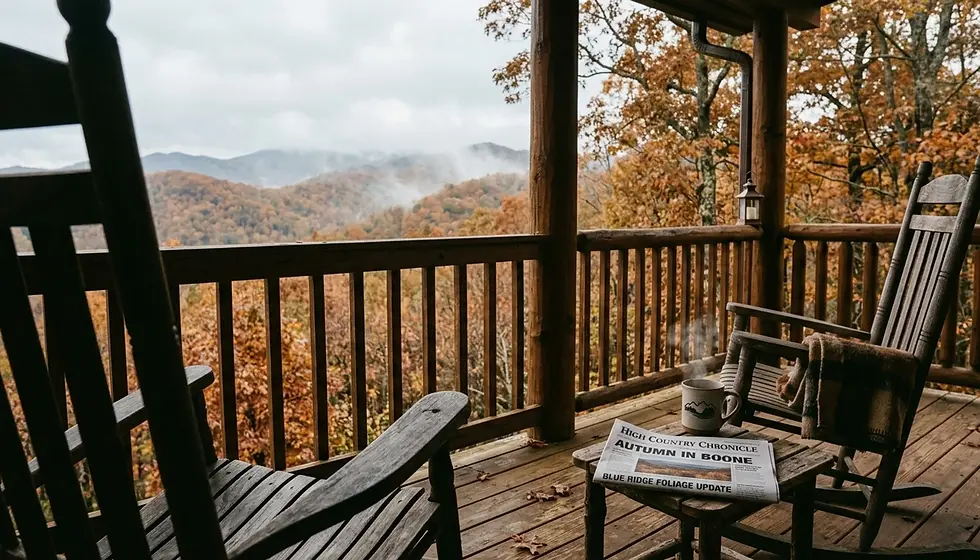
STR revenue in Boone, NC currently ranges from roughly $32,500 to $59,000 per year per listing, depending on which data provider you check and which 12-month window they measured. At 3 Putt Properties, LLC, we manage properties across the High Country and see this exact confusion play out with new owners constantly: they pull one number from a blog post, a different number from a real estate agent, and a third from an Airbnb calculator, and none of the three agree. The gap is not a mistake. It reflects real differences in dataset size, date range, and whether the source reports median or average revenue.
Key Takeaways
Boone STR revenue estimates for 2026 span from $32,503 (AirROI) to $59,052 (GetChalet), with Airbtics reporting a $55,000 median and AirDNA citing roughly $35,600.
Occupancy figures also diverge sharply: 36.2% (AirROI) versus 53% (Airbtics), largely because of different measurement windows and listing samples.
October is consistently the strongest month across every dataset, reaching approximately 66% occupancy according to GetChalet's 2026 data.
Watauga County collects a 6% occupancy tax on gross rental income, and properties inside Town of Boone limits need an STR permit in an approved zoning district.
Full-service Boone property management typically runs 15% to 25% of gross booking revenue, a cost that professional dynamic pricing is designed to offset.
North Carolina posted a record $37.2 billion in visitor spending in 2026, and Watauga County alone saw $515.85 million in visitor spending in 2026, according to Visit North Carolina.
If you own a cabin near downtown Boone or you're weighing whether Appalachian State University's roughly 21,798 students create year-round demand worth capitalizing on, the honest answer is that the market is real but the reporting on it is messy. Every major analytics provider, Airbtics, AirDNA, GetChalet, and AirROI, samples a different slice of the roughly 600 to 2,200 active Boone listings tracked at any given time, over a different 12-month window.
This guide compares those four sources side by side, reconciles why their numbers diverge so much, and builds a property-level model that shows what actually lands in your pocket after platform fees, cleaning, taxes, and management costs. We manage listings from Boone to Beech Mountain and we've watched owners make pricing decisions off a single headline number without ever seeing the full range. In 2026, that mistake is more expensive than ever given how much the market has shifted year over year.
What Is STR Revenue in Boone, NC Right Now?
STR revenue in Boone refers to the gross income a short-term rental property generates from bookings before expenses, and in 2026 that figure varies enormously by data source. Airbtics reports a $55,000 median for the year spanning February 2026 through January 2026, based on roughly 2,200 active listings. AirROI, covering August 2026 through July 2026, reports a lower $32,503 average across 615 listings.
The difference is not a contradiction, it is methodology. Airbtics and GetChalet tend to report figures closer to $48,000 to $59,000 annually, while AirDNA and AirROI cluster in the $32,000 to $36,000 range. Specifically, AirROI's dataset shows 36.2% occupancy and a $346 average daily rate (ADR), producing a $115 revenue per available night (RevPAR). GetChalet's 2026 snapshot shows 51% occupancy and a $342 ADR for the same market.
As a result, owners comparing quotes or evaluating their own listing's performance need to ask which provider, which date range, and whether the number is a median (typical middle-of-the-pack property) or an average (which large luxury cabins can skew upward). Neither figure is wrong. They are measuring different populations of properties.
How Do Airbtics, AirDNA, GetChalet, and AirROI Compare on Boone Numbers?
The four leading STR analytics providers report meaningfully different Boone revenue figures because each pulls from a different listing sample and calendar window. Airbtics counted approximately 2,200 active listings for February 2026 through January 2026, while AirROI's August 2026 to July 2026 window captured only 615. That sample size gap alone explains much of the spread.
Data Source | Reporting Period | Avg/Median Annual Revenue | Occupancy | ADR | Active Listings |
Airbtics | Feb 2026 - Jan 2026 | $55,000 (median) | 53% | $278 | ~2,200 |
GetChalet | 2026 annual | $59,052 (avg) | 51% | $342 | varies by snapshot |
GetChalet (alt snapshot) | Trailing 12 mo. | $48,173 (avg) | 51% | $271 | 539 |
AirDNA | Trailing 12 mo. (2026) | ~$35,600 | 47% | $330 | 951 (June 2026) |
AirROI | Aug 2026 - Jul 2026 | $32,503 (avg) | 36.2% | $346 | 615 |
Notice that ADR is fairly consistent across sources, generally clustering between $271 and $346. The real variance comes from occupancy, which swings from 36.2% to 53% depending on the provider. For example, AirROI's lower occupancy figure combined with a high ADR still produces a lower RevPAR ($115) than what Airbtics implies. Additionally, Homes in Triad NC cites a separate benchmark of $52,000 annual revenue at 53% occupancy and a $272 ADR across 2,193 listings, landing closer to the Airbtics figure.
The practical lesson: never quote a single Boone STR revenue number without stating its source and date range. When we run a revenue analysis for a new managed property, we pull from multiple providers and weight the numbers against the property's specific bedroom count, location, and amenity set rather than leaning on one headline figure.

What Is a Realistic Monthly and Seasonal Revenue Breakdown?
Monthly STR revenue in Boone follows a predictable seasonal curve, with October consistently the strongest month and April or May typically the weakest. GetChalet's 2026 data shows October reaching 66% occupancy at a $312 ADR, while AirROI identifies April as its lowest-earning month in the same year.
Specifically, GetChalet reported July at 61% occupancy with a $340 ADR, and August at 58% occupancy with a $339 ADR, meaning summer and fall leaf season carry the bulk of annual revenue. Winter months soften: GetChalet's 2026 seasonal summary shows 49% average occupancy in winter compared to 57% in summer.
AirROI's 2026 analysis breaks this down further by dollar figures. It reported median monthly revenue at $2,813, with top-quartile properties earning $4,836 or more per month and top-10% performers clearing $7,745 or more. Bottom-quartile properties, by contrast, averaged around $1,520 per month. That is nearly a fivefold spread between the weakest and strongest quartile of Boone listings, driven mostly by amenity quality, bedroom count, and proximity to attractions like the Blue Ridge Parkway.
The same dataset shows seasonal average monthly revenue of $4,775 in peak season versus $2,503 in low season, with peak-season occupancy at 44.3% against 33.5% in low season. Owners who price flatly across the calendar leave meaningful revenue on the table during October and July while overpricing themselves out of bookings in slower months.
What Is the 80/20 Rule for Airbnb?
The 80/20 principle applied to Airbnb generally suggests that a small share of a host's actions, typically pricing strategy, listing quality, and guest communication speed, drive the large majority of booking performance and revenue. It is not an official Airbnb policy but a commonly cited operating framework among hosts and revenue managers.
In the Boone market specifically, we've seen this play out in a concentrated way: properties with professional photography, accurate amenity tagging, and dynamic pricing tend to outperform comparable cabins that were priced once and left alone. A five-bedroom cabin near downtown Boone with a hot tub and game room, similar in scale to Mountain Bliss Chalet, a property in our own portfolio just four miles from downtown Boone and Appalachian State, captures premium rates specifically because those high-leverage details were addressed upfront.
Rather than treating every listing decision as equally important, focus first on the handful of levers that move revenue the most: nightly rate calibration by season, response time to inquiries, and whether your listing photos accurately represent amenities like fire pits, mountain views, or proximity to the Blue Ridge Parkway.
Are Airbnbs Still Profitable in 2026?
Airbnb properties in Boone remain profitable in 2026 for owners who manage costs carefully and price seasonally, though margins have tightened compared to the rapid growth years earlier in the decade. AirDNA's June 2026 data shows 951 active Boone listings, down 9.9% year over year, suggesting some marginal operators have exited the market.
At the same time, demand fundamentals remain strong. North Carolina posted $37.2 billion in statewide visitor spending in 2026, up 1.3% from 2026, and Watauga County alone generated $515.85 million in visitor spending in 2026 according to Visit North Carolina. Airbtics also reported Boone revenue growth of 20.3% year over year in its most recent measurement window, even as occupancy held flat at 53%.
Profitability now depends more on execution than on simply owning a listing in a growing market. Professional STR management typically delivers 20% to 40% higher annual revenue than self-management, primarily through dynamic pricing and occupancy optimization, a gap that matters more as the market matures and mediocre listings get squeezed by better-run competitors.
How Much Does the Average Vrbo Owner Make in Boone?
Vrbo revenue in Boone tracks closely with Airbnb revenue since most professionally managed properties list on both platforms simultaneously, and industry-wide data does not typically separate Vrbo-only performance from blended multi-channel revenue. The Boone-specific figures cited throughout this article, spanning $32,503 to $59,052 annually depending on provider, generally reflect combined or Airbnb-dominant booking data since Airbnb remains the larger channel by listing volume in most US mountain markets.
What we do know from managing properties across both platforms: Vrbo tends to attract a slightly different guest profile, often larger family groups booking further in advance, which can complement Airbnb's shorter-lead-time bookings. AirROI's Boone dataset shows an average booking lead time of 61 days, and Vrbo bookings in our experience tend to skew toward the longer end of that window, particularly for multi-week summer and fall stays.
A listing distributed only on Airbnb, ignoring Vrbo and Booking.com, is leaving a portion of that demand curve unaddressed. Multi-platform distribution has become the practical minimum for competitive Boone STR performance in 2026, not an optional add-on.

What Drives Revenue Differences by Property Size and Location?
Property-level revenue variation in Boone depends heavily on bedroom count, distance to Appalachian State University and downtown, and amenity density, not just which analytics platform you trust. A studio or one-bedroom condo near campus performs very differently than a five-bedroom mountain cabin with a game room and mountain views.
Larger group-oriented cabins, similar to our own Hanley Lane Rd property with four bedrooms and capacity for 12 guests, tend to command higher total nightly rates even at similar occupancy percentages, because the per-night rate scales with guest capacity. A cabin sleeping 12 that books at $400 a night generates meaningfully more monthly revenue than a two-bedroom condo booking at $150 a night, even if both sit at 50% occupancy.
Distance also matters. Properties within a short drive of downtown Boone, Appalachian Ski Mountain, or the Blue Ridge Parkway generally hold occupancy better during shoulder months than properties requiring a longer drive to attractions. Homes closer to Appalachian State also see incremental demand during parents' weekends and graduation, windows that generic market averages don't capture.
This is exactly the kind of property-specific analysis that generic blog averages miss, and it's why we run individualized revenue projections for every property we take on rather than quoting a single market-wide number to a new owner.
What Does a Full Revenue and Expense Model Look Like?
A realistic Boone STR financial model starts with gross revenue and subtracts platform fees, cleaning, utilities, maintenance, insurance, taxes, and management costs to arrive at net cash flow, a step most market data reports skip entirely. Using a mid-range figure of $48,000 in annual gross revenue as a baseline example:
Expense Category | Typical Range (% of Gross or Flat) | Notes |
Platform fees (Airbnb, Vrbo) | 3% (host-only) or built into guest fees | Varies by platform and fee structure chosen |
Watauga County occupancy tax | 6% of gross rental income | Applies to properties inside county per Homes in Triad's rules summary |
Cleaning and turnover | Varies by property size | Larger cabins with more bedrooms cost more per turn |
Utilities, internet, streaming | Ongoing fixed cost | Higher in winter with heating demand |
Maintenance and repairs | Varies, budget conservatively | Older mountain properties often need more |
Insurance (STR-specific policy) | Ongoing fixed cost | Confirm your policy covers short-term rental use |
Full-service management fee | 15%-25% of gross booking revenue | Typically includes pricing, guest comms, and turnover coordination |
After stacking the county's 6% occupancy tax, a management fee in the 15% to 25% range, and operating costs like cleaning and utilities, an owner grossing $48,000 might net considerably less depending on how efficiently those costs are managed. This is precisely why ADR and gross revenue headlines can mislead: gross revenue is not owner income, and two properties with identical gross revenue can produce very different net cash flow depending on expense discipline.
If you're trying to figure out whether your own property pencils out, our detailed breakdown of what property management actually costs in Boone walks through fee structures in more depth.
What Is the 75-55 Rule in Airbnb?
There is no verified, industry-standard "75-55 rule" for Airbnb hosting, and owners should be cautious of any framework presented as an official rule without a clear, credible source. What matters far more for Boone owners is tracking your property's actual occupancy and ADR against the ranges reported by Airbtics, AirDNA, GetChalet, and AirROI, rather than chasing a memorized formula.
If you've seen this term referenced elsewhere, treat it skeptically. The real, verifiable benchmarks for Boone in 2026 are the ones outlined earlier in this article: occupancy ranging from 36.2% to 53% depending on provider, and ADR generally between $271 and $346. Top-performing properties, per AirROI, reach occupancy above 75% at nightly rates above $570, which is a legitimate performance tier worth aiming for, but it comes from actual reported data, not a named rule.
What Permits and Taxes Apply to Boone Short-Term Rentals?
Short-term rental operators inside Town of Boone limits generally need an STR permit and must operate within an approved zoning district, while Watauga County applies a 6% occupancy tax on gross rental income regardless of where inside the county the property sits. These are the two compliance layers every Boone owner needs to confirm before listing.
Zoning matters more than many first-time owners expect. A property that looks like a perfect rental on paper may sit outside a permitted STR zoning district, which would block legal short-term operation entirely. Always confirm current zoning and permit status directly with the Town of Boone before purchasing or converting a property.
Occupancy tax compliance is separate from federal and state income tax obligations and applies specifically to the rental transaction itself. Because permit rules and tax requirements change periodically, always verify current figures and zoning maps with the official Town of Boone and Watauga County offices rather than relying on secondhand blog summaries, including this one. For a deeper look at how these rules apply across the wider region, see our guide to Boone's short-term rental ordinance.
How Should Owners Choose Between Self-Managing and Professional Management?
The choice between self-managing and hiring a professional manager comes down to whether you can consistently execute dynamic pricing, multi-platform distribution, and same-day guest response across every season, or whether that operational load is better handed off. Self-management works for owners with time, local presence, and a genuine interest in the operational details. It struggles for out-of-state owners or those juggling multiple properties.
Audit your current pricing approach. If your nightly rate has not changed in the last 60 days despite shifting demand, you're likely leaving revenue on the table during peak periods like October leaf season.
Check your platform coverage. If you're listed only on Airbnb, calculate what percentage of Boone searchers you might be missing on Vrbo and Booking.com.
Review your response time data. Airbnb's own performance metrics penalize slow replies, which compounds into lower search ranking over time.
Calculate your true hourly cost. Add up hours spent on guest messages, cleaner coordination, and pricing adjustments, then multiply by what your time is worth.
Compare that cost against a management fee. Full-service Boone management commonly runs 15% to 25% of gross revenue, a cost that dynamic pricing and better occupancy can often offset.
Common mistakes we see repeatedly: setting a rate once at listing launch and never revisiting it, ignoring shoulder-season demand from App State parents' weekends, and underpricing the property to guarantee bookings rather than testing what the market will actually bear during October and July peaks.
Frequently Asked Questions
Are there cabins available in Boone, North Carolina?
Yes, Boone has a wide range of cabin rentals, from compact two-bedroom units to large multi-generational properties sleeping 12 or more guests. Availability and pricing shift seasonally, with the strongest demand and highest rates typically occurring during October leaf season and Appalachian State University event weekends.
How much does the average Vrbo owner make?
Vrbo-specific revenue data for Boone is not typically reported separately from blended multi-platform figures, but properties distributed across both Airbnb and Vrbo generally perform better than single-platform listings. Boone's overall STR revenue benchmarks range from roughly $32,500 to $59,000 annually depending on the data provider and measurement period.
What is the 80/20 rule for Airbnb?
It's a general principle suggesting that a small number of high-impact actions, like pricing strategy and listing quality, drive most of a property's booking performance, rather than an official Airbnb rule. In Boone, that typically means dynamic seasonal pricing and accurate amenity photography matter more than smaller listing tweaks.
Are Airbnbs still profitable in 2026?
Boone Airbnbs remain profitable in 2026 for well-managed properties, supported by North Carolina's record $37.2 billion in 2026 visitor spending and Watauga County's $515.85 million in 2026 visitor spending. Profitability now depends more on pricing execution and cost management than simply owning a listing in a growing market.
What is the 75-55 rule in Airbnb?
There is no verified industry-standard "75-55 rule" for Airbnb hosting. Owners should rely on actual reported Boone market data instead, such as occupancy ranging from 36.2% to 53% and ADR between roughly $271 and $346 depending on the data source.
How much does a property manager charge for a vacation rental in Boone, NC?
Full-service short-term rental management in Boone typically costs between 15% and 25% of gross booking revenue, covering pricing, guest communication, and turnover coordination. Co-hosting arrangements, where the owner retains listing ownership, generally run lower, closer to 10% to 18% of gross revenue.
Do I need a permit to operate a short-term rental in Boone, NC?
Properties located inside Town of Boone limits generally need an STR permit and must sit within an approved zoning district. Watauga County additionally applies a 6% occupancy tax on gross rental income, so confirm both permit status and tax registration with the relevant local offices before listing.
Conclusion: What Should Boone Owners Take Away From This?
STR revenue in Boone genuinely spans from around $32,500 to $59,000 a year depending on the data source, and no single number tells the full story of what your specific property can earn. What matters more than chasing the highest headline figure is understanding your property's bedroom count, location relative to Appalachian State and downtown, and how aggressively you adjust pricing across October's leaf-season peak versus April's slow season.
As the Boone market matures through 2026, with AirDNA reporting listing counts down nearly 10% year over year even as revenue per listing grows, the gap between well-managed and passively managed properties is widening. Owners who treat pricing, platform distribution, and compliance as ongoing work, not a one-time setup task, are the ones capturing the top-quartile numbers this article outlined.

If your Boone property's revenue doesn't match the ranges outlined here, or you're not sure which numbers even apply to your specific cabin, 3 Putt Properties, LLC offers a free property revenue analysis for owners across Boone, Banner Elk, Beech Mountain, and Blowing Rock. We compare your listing against the actual providers cited in this guide, not a single averaged number, and build a pricing strategy around your property's specific bedroom count, location, and season. Reach out through 3 Putt Properties, LLC to see what a tailored revenue plan could look like for your cabin.
Written by Eric McCarty, Found, CEO at 3 Putt Properties, LLC
Content powered by inkSTR.co


Comments