%20-%20Hi%20Res%201_edited.png)
%20-%20Hi%20Res%201.png)
10 Vacation Rental Interior Design Choices That Pay Off


Vacation rental interior design is the single most underestimated revenue lever available to short-term rental owners. Most operators spend months obsessing over pricing strategies and OTA algorithms while leaving 20 to 40% more nightly rate on the table because their property looks like a clearance sale at a furniture outlet. At 3 Putt Properties, LLC, we manage properties across Banner Elk, Beech Mountain, Boone, Surf City, and Wrightsville Beach, and the pattern we see repeatedly is this: thoughtful design choices translate directly into bookings, premium rates, and better reviews. This article breaks down 10 specific design decisions that guests consistently notice and that owners consistently profit from in 2026.
Professionally designed vacation rentals command 20 to 40% more per night than comparable properties furnished without a design strategy, according to Paragon Stays.
A property earning $200 per night can reach $250 to $320 after a thoughtful redesign, according to AvantStay's 2026 data.
Quality photography after a design refresh produces 10 to 20% immediate revenue increases, making photography inseparable from the design investment.
Strategic, targeted upgrades produce outsized ROI: one Asheville property owner added a $300 vintage bench and planters and achieved a 40% increase in booking photo clicks and a $25 per night rate increase, per Sukkha Interior Design.
The highest-impact design choices are not the most expensive ones. Lighting, bedding, and furniture layout consistently outperform full renovations in per-dollar return.
Location-specific design themes (ski chalet, coastal cottage, mountain lodge) convert better than generic "hotel neutral" aesthetics in leisure travel markets like the High Country and the NC coast.
Rental owners in competitive markets like Banner Elk and Surf City are no longer competing only on location and price. As of 2026, travelers routinely scroll past dozens of listings in seconds, choosing the property whose photos stop them mid-scroll. That split-second decision is almost entirely a design outcome. The good news: you do not need a $50,000 renovation budget to compete. You need the right ten decisions made in the right order.
The TouchStay vacation rental interior design guide puts design budgets in useful context, noting that a small, basic property can be transformed for as little as £3,000 while a larger, high-end home might invest up to £50,000. Most owners operating in mid-tier markets like the NC mountains fall somewhere between those poles, and the choices below are ranked by impact per dollar spent, not by total price tag.
1. Does Your Color Palette Match Your Location's Identity?
Vacation rental color strategy refers to the deliberate selection of wall colors, furniture tones, and accent hues based on a property's specific market, guest profile, and setting. A mountain cabin in Banner Elk, NC, should not look like a Miami Airbnb. A Surf City beach house should not carry the same aesthetic as a Beech Mountain ski chalet. Location-matched palettes convert better because they reinforce the specific experience a guest is paying for.
The industry-standard framework is the 60-30-10 rule: 60% dominant color across walls and large furniture, 30% secondary color in curtains and rugs, and 10% accent color in pillows and art. For High Country mountain cabins, this typically means warm wood tones and creamy neutrals as the dominant layer, forest greens or slate blues as secondary, and copper or amber accents. For coastal properties near Wrightsville Beach or Surf City, pale sand, ocean blue, and natural linen textures follow the same formula.
The Guesty vacation rental guide emphasizes that color psychology directly influences perceived value. Warmer tones feel more premium in winter bookings, while cooler coastal palettes increase perceived cleanliness, which directly impacts review scores. Avoid the common mistake of painting every room the same agreeable greige. Guests notice and appreciate a property that has a coherent visual story, not just inoffensive walls.
Skip trendy colors that will look dated in two seasons. Timeless, location-specific neutrals with deliberate accent layering photograph well year-round and require fewer touch-ups between guest stays.

2. What Does Your Bedding Say About Your Nightly Rate?
Bedding quality is the single most-noticed design element in guest reviews across every market we serve. White hotel-quality linens function as a baseline expectation at this point, not a differentiator, but properties that fall below that baseline see it reflected immediately in review language and star ratings.
The standard recommendation from JJones Design Co., referenced in their Airbnb design guide, is to start with a white foundation for duvets and sheets, then layer in accent pillows and throws that reflect the property's location theme. For a ski cabin on Beech Mountain, this might mean plaid or herringbone throw blankets and rust-colored Euro shams. For South Shore Chateau in Surf City, it means white coastal quilts with navy accents that read "beach house" in thumbnail photos.
The practical reason to use white bedding goes beyond aesthetics. White reads as clean in photos, and photos taken immediately post-staging are what fill your listing. White also bleaches well, which matters enormously for high-turnover properties where guests occasionally bring wine, makeup, and sunscreen to bed.
Invest in a commercial-grade mattress, not a consumer mattress. The difference in durability over 200 guest stays is significant, and a good mattress is cited in reviews far more often than most owners expect. Budget accordingly: a quality king mattress with a commercial sleep life is one of the highest-ROI purchases in vacation rental interior design.
3. How Much Does Furniture Quality Actually Affect Your Revenue?
Furniture quality in short-term rentals refers to the durability, visual weight, and guest-perceived value of sofas, dining tables, bed frames, and accent chairs selected for a vacation rental property. The two most common furniture mistakes are buying pieces that look acceptable in person but photograph poorly, and buying pieces built for residential use that deteriorate within 18 months of vacation rental turnover.
Decorilla's design guidance recommends investing in high-quality, durable furniture that improves with age, then using easily swappable accent pieces to follow seasonal trends without replacing structural furniture. This is exactly the right framework. Your sofa, dining table, and bed frames are long-term capital expenditures. Your throw pillows, table runners, and seasonal decor are operating expenses. Treat them differently in your budget.
For large-group mountain properties like Twin Cubs Cabin, which sleeps 14 guests across 3,000 square feet in Banner Elk, every furniture purchase needs to survive the equivalent of a hotel's commercial use load. Recliner sofas in game rooms, bunk bed frames in kids' rooms, and dining tables that seat 8 or more all need commercial-grade construction. A consumer-grade sofa will show wear within a single ski season of heavy family use.
Vacasa's furnishing guidance correctly prioritizes stain-resistant fabrics for high-traffic seating. Microfiber and performance weave fabrics in sofas and armchairs handle guest turnover far better than cotton or linen blends. This is especially relevant in beach markets: sand, sunscreen, and salt air accelerate fabric deterioration faster than most owners anticipate.
One concrete reference point: Sukkha Interior Design documented a client who spent $8,000 updating a rental's kitchen and bathroom, achieved a $400 per month rent increase, and recovered the investment in under two years. Targeted furniture and fixture upgrades follow a similar payback curve when chosen with photography and guest experience in mind.

4. What Lighting Changes Have the Highest ROI Per Dollar?
Lighting strategy in vacation rental interior design refers to the layered use of ambient, task, and accent lighting to create spaces that feel warm and functional in person and photograph well for listing photos. Most vacation rentals are severely underlighted, relying on a single overhead fixture per room. This produces flat, unflattering photos and makes spaces feel institutional rather than inviting.
The highest-ROI lighting change you can make is adding floor lamps and table lamps to living areas and bedrooms. A $150 floor lamp in a dark corner of a living room changes the entire character of that space in listing photos. Specifically, warm-toned bulbs in the 2700K to 3000K range make wood tones richer, fabrics more inviting, and mountain views through windows more dramatic.
The Lodgify blog specifically recommends providing adequate lighting near beds, armchairs, and kitchen workspaces. Task lighting at bedside reading positions and kitchen counters is the design detail that makes guests feel the property was designed for them, not decorated for a photo and then handed over. A property that functions well at night feels more luxurious than one that is attractive at noon and useless after dark.
Pendant lighting over kitchen islands and dining tables adds perceived value and photographs well with minimal investment. For a High Country cabin with a vaulted tongue-and-groove ceiling, replacing a basic ceiling fan with an exposed-bulb chandelier or a statement pendant can shift the visual tier of the entire space. Budget $200 to $500 for a statement dining pendant and consider it one of the most visible per-dollar upgrades available.
Exterior lighting also belongs in this conversation. A well-lit deck, hot tub area, or fire pit space looks dramatically more premium in evening photos and makes properties feel safer and more intentional. String lights over a deck cost under $50 and routinely appear in the photos guests take and share online.
5. Why Does Local Art and Decor Move the Revenue Needle?
Local art and regional decor in vacation rental interior design refers to artwork, photography, textiles, and decorative objects that connect a property's interior to its specific geographic identity and regional character. Properties that use local art consistently outperform generic-decor properties in the same market because they give guests something to photograph, post, and remember.
Lodgify's guidance on this point is direct: use large local art and hang it at eye level. A small print in a thin IKEA frame reads as an afterthought in listing photos. A 24-by-36-inch framed print of Grandfather Mountain's swinging bridge, hung at proper eye level in a Banner Elk cabin, becomes a conversation piece and a photo opportunity for guests. That photo ends up in Instagram posts and review photos, providing marketing reach the owner did not have to pay for.
For coastal properties near Topsail Island and Surf City, local art might mean framed nautical charts of the Intracoastal Waterway, hand-thrown pottery from NC coast studios, or large-format photography of the island's barrier beach landscape. The key is specificity. Art that clearly says "this is Surf City, North Carolina" performs better in booking photo conversions than art that says "beach house" in a generic way.
The Airbnb Host Resource Centre, which serves as a primary platform standard for design and hosting expectations, emphasizes the role of local touches in creating a sense of place that generates repeat bookings and strong reviews. Guests who feel a connection to the specific place they chose are more likely to return and more likely to recommend. Local decor is the fastest way to create that connection at scale.
One caveat: avoid importing "local" decor from mass-market retailers. A generic barn wood sign that says "Mountains are calling" is not local art. It is the same sign in 40,000 other Airbnb listings. Real local sourcing means purchasing from regional artists, craft fairs, or regional galleries, which also supports the community the property operates in.
6. How Should You Design for Multiple Guest Segments Without Starting Over?
Designing a vacation rental for multiple guest segments means creating a property layout and amenity mix that serves families with children, multi-generational groups, couples, and friend groups without requiring a complete redesign each time your target market shifts. This is a content gap that most design guides miss entirely, and it represents a genuine competitive advantage in markets like the High Country, where a cabin might host a ski group in February and a family reunion in July.
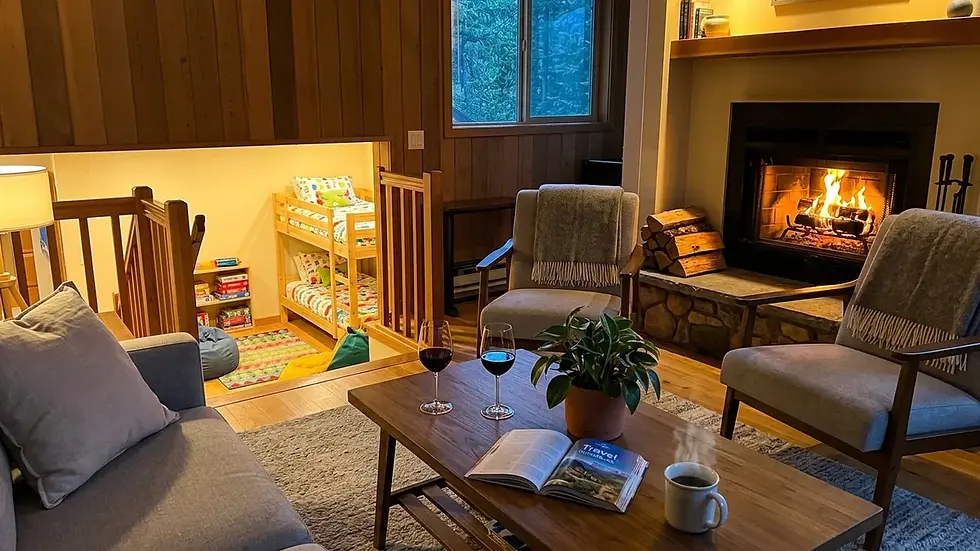
The solution is zoned amenity design. Specifically, create distinct functional zones within the property rather than one undifferentiated communal space. A basement or lower level game room with bunk beds, arcade systems, and a pool table serves both children and competitive adult groups. A main-level open living area with ample seating and a kitchen island serves couples and seniors. A private deck with a hot tub serves adults who want to separate from the kids' energy downstairs.
Two Bears Den on Beech Mountain illustrates this approach in practice. The property's design includes a double-sided fireplace that warms both the living room and dining area simultaneously, floor-to-ceiling windows that frame mountain views from the main social space, and a dedicated arcade game room with over 10,000 games that keeps children occupied independently. The result is a property that works for a family of 15 without feeling like a compromise for any member of the group.
The same logic applies to beach properties. South Shore Chateau in Surf City features separate living areas on multiple floors, a garage game space with a pool table and PS5 setup, sunrise decks facing the Atlantic for adults, and a dedicated bunk room for children. Each zone serves a distinct guest segment. No guest has to negotiate for space with someone who wants to do something different.
When you pivot design for remote workers, add one dedicated work zone with a quality chair, good task lighting, and a surface wide enough for a laptop and a second monitor. This single addition opens your property to business travel demand in shoulder seasons without changing anything else about the guest experience. It requires roughly $400 to $600 in targeted furniture and costs nothing to market once it appears in your listing photos.
7. What Does a Well-Designed Kitchen Actually Signal to Guests?
Kitchen design in short-term rentals is a functional and perceptual signal to guests about the quality of the overall property. A well-stocked, well-organized kitchen communicates that the owner thought carefully about the guest experience. A sparse, disorganized kitchen with mismatched utensils and a non-functional can opener communicates the opposite, and guests mention kitchens specifically in reviews more often than most owners realize.
The JJones Design Co. Airbnb design guide specifically highlights kitchen stocking as a driver of repeat bookings and strong reviews. The baseline for a property targeting 4 to 5 star reviews includes: a quality coffee maker (Keurig or drip, plus a French press for the coffee snobs), a blender capable of handling frozen fruit without dying, a complete set of matching cookware, and a full knife block with sharpened knives. A dull knife in a rental kitchen is a disproportionate irritant. Guests notice.
For large-group properties, scale the kitchen infrastructure to match. Twin Cubs Cabin in Banner Elk seats 8 at the dining table and 4 at the kitchen bar. A kitchen feeding 12 people for a mountain ski weekend needs 12 matching plates and bowls, enough glasses for a full group plus extras, and adequate bakeware for oven-cooked family meals. Underinvesting in kitchen capacity at a 5-bedroom cabin is a review problem waiting to happen.
Kitchen aesthetics matter too. Matching canisters on the counter, a coordinated hand towel set, and a small herb plant or succulent near the window all read as intentional in listing photos. The Airbnb Community beginner's guide to decorating emphasizes clear-purpose spaces and uncluttered surfaces. In kitchens, this means storing rarely used items out of sight and keeping counters photo-ready without appearing bare.
8. How Do Smart Technology and Practical Amenities Affect Guest Perception?
Smart home technology in vacation rental interior design refers to keyless entry systems, smart TVs with streaming access, voice assistants, and high-speed WiFi infrastructure that guests increasingly expect as baseline requirements rather than premium features. In 2026, a property without Roku or Apple TV streaming is at a disadvantage in listing searches because guests filter for these amenities.
Keyless entry is not a luxury. It is an operational necessity. Guests who arrive after a long drive to a Beech Mountain cabin do not want to coordinate key pickup at 10pm. A smart lock eliminates this friction entirely, improves check-in reviews, and reduces the operational burden of physical key management across multiple properties. The cost is typically $150 to $300 per door and pays for itself in avoided guest service issues within the first few months.
WiFi speed matters more than most owners budget for. A 5-bedroom mountain cabin hosting 14 guests simultaneously streaming video, gaming online, and video-calling will overwhelm a standard residential internet plan. Many properties in the High Country can access 300 to 400 Mbps fiber options that cost marginally more than entry-level service and eliminate one of the most common guest complaints in mountain rental markets. Twin Cubs Cabin lists 380 Mbps WiFi specifically because it is a differentiator guests search for and mention in positive reviews.
For design integration, conceal router hardware where possible and route cable TV and gaming console cords through wall channels or cord covers. Visible cable clutter reads as unfinished in listing photos and is one of the small details that separates a property that looks designed from one that looks assembled. Smart TVs should be mounted at proper viewing height, not set on dressers, and each bedroom should have its own streaming-capable TV as guests in 2026 expect independent viewing access in sleeping spaces.
9. What Outdoor Spaces Do to Your Listing's Competitive Position?
Outdoor design for vacation rentals refers to the intentional staging of decks, patios, fire pit areas, hot tubs, and exterior seating to create spaces that guests want to use and photograph during their stay. In mountain and coastal markets, outdoor spaces are often the primary booking driver, and properties that invest in outdoor staging see disproportionate returns relative to the cost.
Hot tubs are the single most searched amenity filter on Airbnb and Vrbo in mountain vacation rental markets. In the High Country specifically, a property with a hot tub and mountain views commands a meaningful nightly rate premium over otherwise comparable properties without one. The property Thistle Be Fun on Beech Mountain features a hot tub positioned to capture long-range mountain views, and that positioning is specifically called out in guest reviews. The hot tub location matters as much as the hot tub itself.
Fire pits, outdoor dining sets, and string lights are the most cost-effective outdoor design investments available. A $300 fire pit setup with Adirondack chairs and a $50 string light installation transforms a basic deck into an evening social space that photographs dramatically better than an empty deck with lawn chairs. Guests document these spaces and share them. That organic social proof is free marketing.
For coastal properties, outdoor showers are both functional and photogenic. South Shore Chateau features an outdoor rinse shower, which is practical after beach days and reads as a thoughtful, resort-caliber detail in listing photos. Outdoor furniture in coastal markets needs UV-resistant materials, specifically powder-coated aluminum or teak, because salt air and sun destroy lesser materials within a season or two.
One honest caution: do not add an outdoor amenity you cannot maintain. A hot tub that is not serviced properly generates negative reviews that cancel out the booking premium it creates. If you manage a property from out of state, factor professional hot tub maintenance into your operating budget before adding one. The team at 3 Putt Properties manages hot tub maintenance as part of regular property operations for exactly this reason.
10. What Are the Highest-ROI Design Upgrades When Your Budget Is Limited?
High-ROI vacation rental design upgrades are specific, targeted changes that produce measurable improvements in nightly rate, occupancy, or review scores at a fraction of the cost of full renovations. This is where most design guides fail property owners: they recommend broad aesthetic overhauls without helping owners prioritize where limited dollars produce the greatest return.
The evidence here is specific. Per Sukkha Interior Design's documented case studies from the North Carolina market, a West Asheville vacation rental achieved a 98% occupancy rate after spending $15,000 on strategic updates including better lighting, functional furniture, and an outdoor fire pit area. Separately, a single $300 front porch addition generated a 40% click increase in booking photos and a $25 per night rate increase, producing a 3,000% ROI in year one.
The ranking below reflects what we observe across the properties 3 Putt Properties manages across the High Country and the NC coast, ordered by typical per-dollar impact:
Upgrade | Typical Cost Range | Primary Benefit | Best For |
White hotel bedding set (king) | $150 to $300 per bed | Immediate photo impact, cleanliness perception | All property types |
Layered lighting (floor lamps) | $100 to $300 per room | Photography quality, ambiance, review language | All property types |
Statement pendant over dining table | $200 to $500 | Perceived value, visual anchor for photos | Open-plan cabins, beach houses |
Large local art (24x36 or larger) | $200 to $600 per piece | Booking photo differentiation, guest photos | All markets |
Outdoor string lights and fire pit setup | $300 to $800 | Evening photo appeal, social sharing, reviews | Mountain cabins, beach houses |
Kitchen upgrade (cookware, coffee maker) | $400 to $900 | Review language, repeat bookings | Large-group, family properties |
Smart lock installation | $150 to $300 per door | Check-in reviews, operational efficiency | All property types |
Area rug (living room, bedrooms) | $200 to $600 | Photo warmth, noise reduction, perceived luxury | Hardwood and tile floor properties |
If your budget is under $2,000, prioritize bedding first, lighting second, and one piece of large local art third. These three changes have the highest probability of immediately visible improvement in listing photos and the fastest payback in nightly rate increases. See our guide to short-term rental design for a deeper breakdown of property-specific design approaches.
If your budget is $5,000 or more, add the fire pit or outdoor upgrade, a dining pendant, and a full kitchen restock. Then schedule a professional photoshoot immediately after staging. According to AvantStay's 2026 analysis, quality photography following a design refresh produces 10 to 20% immediate revenue increases, making the photoshoot itself a required part of the design investment, not an optional add-on.
Frequently Asked Questions About Vacation Rental Interior Design
How much should I budget for vacation rental interior design?
Budget depends on property size and starting condition. According to the TouchStay vacation rental interior design guide, small properties can be effectively designed for around $3,000 to $5,000, while larger high-end homes may invest up to $50,000. Most mid-tier mountain or coastal vacation rentals in markets like Banner Elk or Surf City fall between $8,000 and $20,000 for a full design refresh. Targeted upgrades, specifically bedding, lighting, and local art, can produce meaningful results for under $2,000 if your budget is limited and your layout is already functional.
Does vacation rental interior design actually increase revenue?
Yes, and the evidence is specific. Professionally designed vacation rentals command 20 to 40% more per night than comparable properties in the same market that are furnished but not designed, according to Paragon Stays. AvantStay's 2026 data shows a property earning $200 per night can reach $250 to $320 after a thoughtful redesign. Revenue increases come from two sources: higher nightly rate ceiling and improved booking photo conversion, both of which compound over a full booking year.
What is the single most important design element in a vacation rental?
Bedding quality has the highest impact per dollar for guest reviews, but lighting has the highest impact on listing photo quality, which drives initial bookings. The answer depends on whether your challenge is converting viewers to bookings (lighting and layout) or converting bookings to 5-star reviews (bedding, kitchen quality, and functional amenities). Most properties that underperform need both, but if you can only change one thing, upgrade to white hotel-quality bedding first because it improves both photos and in-person guest perception simultaneously.
How do I design a vacation rental for different types of guests without redoing the whole property?
Zoned amenity design is the answer. Create distinct functional areas that serve different guest segments without requiring the entire property to cater to one group. A lower-level game room with bunk beds and entertainment systems serves children and competitive adult groups. A main-level social space with quality seating and a well-stocked kitchen serves adults and couples. A private outdoor hot tub or fire pit area creates an adult retreat space. Each zone serves a segment independently, making the property genuinely functional for families, friend groups, and multi-generational trips without redesign between stays.
Should my vacation rental have a specific design theme?
Yes, specifically a location-matched theme rather than a generic "vacation home" aesthetic. A mountain cabin in Banner Elk, NC should communicate mountain lodge warmth through wood tones, forest palette accents, and local High Country art. A beach house in Surf City should communicate coastal ease through pale linens, natural textures, and nautical or regional art. Location-specific themes convert better in listing thumbnails because they reinforce the experience the guest is paying for. Generic hotel-neutral aesthetics perform worse in leisure travel markets where guests are choosing a destination identity, not just a bed.
How often should I update my vacation rental's interior design?
Plan for a full design refresh every three to five years and targeted updates annually. High-turnover items like throw pillows, area rugs, and decorative accents typically need replacement every one to two years in active short-term rentals. Structural furniture (bed frames, sofas, dining tables) with commercial-grade construction should last five to eight years. Monitor your listing photo performance and review language: when guests stop mentioning the design in positive reviews or start noting that things look "worn," that is the signal that targeted updates are overdue.
Do I need to hire a professional interior designer for my vacation rental?
Not necessarily, but working with someone who has specific vacation rental design experience is meaningfully different from working with a residential designer. Residential designers optimize for aesthetics and client preferences. Vacation rental design requires optimizing for photography performance, guest durability, multi-guest functionality, and location-specific market appeal simultaneously. Companies like 3 Putt Properties offer design consulting specifically calibrated to STR revenue outcomes, which is a different service than general interior design. If you have a clear design direction and a reasonable budget, targeted self-directed upgrades following the priorities above can produce strong results without a full design engagement.
What Should Your Next Step Be as a Property Owner?
Vacation rental interior design is a revenue strategy, not a vanity project. Every choice covered in this guide, from your color palette to your outdoor fire pit layout, connects directly to your nightly rate ceiling, your booking photo conversion, and your review scores. The properties that consistently outperform in competitive markets like Banner Elk and Surf City are not the newest or the largest. They are the ones where every design decision was made with the guest experience and the camera frame in mind simultaneously.
Start with the table in section 10. Pick the three upgrades that apply most directly to your property's current weaknesses. Schedule a professional photoshoot after implementing them, because design investments that are not photographed well do not produce revenue increases. Then evaluate the full list over the next 12 months as your budget allows. Compound these changes over two to three seasons and you will see the difference in your revenue report.
For owners who want to understand how STR revenue management and design strategy work together to maximize a property's annual income, that combination is worth exploring in depth.

If you manage a property in the High Country or along the NC coast and want professional guidance on design choices that directly impact your nightly rate, the team at 3 Putt Properties, LLC offers interior design consulting as part of its full-service property management work. Every property we onboard gets a design and staging review before it goes live, because we know the revenue difference it makes from the first booking forward.
Written by Eric McCarty, Found, CEO at 3 Putt Properties, LLC
Content powered by inkSTR.co
Comments