%20-%20Hi%20Res%201_edited.png)
%20-%20Hi%20Res%201.png)
STR Revenue Surf City: 2026 Numbers Every Owner Should Know


STR revenue in Surf City, NC ranges from roughly $35,442 to $41,851 in average annual gross income per listing, depending on which 2026 dataset you reference, with top-performing properties clearing $10,000 or more per month during peak season. At 3 Putt Properties, LLC, we manage two properties on Topsail Island and see firsthand how the gap between a median-performing listing and a top-tier one usually comes down to pricing strategy, not luck.
Key Takeaways
AirDNA-sourced AirROI data puts average annual STR revenue in Surf City at $35,442 with a 33.5% occupancy rate and $428 average daily rate (ADR) for the August 2026 to July 2026 period.
A separate 2026 Topsail Island market report from Crest & Cove shows $41,851 average annual revenue with 37.7% occupancy across 733 active Surf City listings, a reminder that dataset windows change the headline number.
Peak season (June through August) monthly revenue runs $7,668 to $9,062 depending on the source, while low season (January, February, November) drops to $2,536 to $2,287 per month.
Top 10% of Surf City listings hit 75% or higher occupancy; the bottom 25% average closer to 14% to 19%, a spread almost entirely explained by pricing and listing quality.
Surf City charges a 6% occupancy tax plus additional local and county rental taxes, which owners must factor into net income projections, not just gross revenue.
Gross revenue figures can be misleading. One address-level Chalet analysis showed a property earning $48,456 in annual revenue but a modeled negative $41,952 net income once expenses were deducted.
What Does STR Revenue Mean for a Surf City Property?
STR revenue refers to the total gross income a short-term rental property generates from bookings before any expenses, taxes, or management fees are deducted. In Surf City, NC, that figure typically gets measured across four core metrics: average daily rate (ADR), occupancy percentage, RevPAR (revenue per available night), and total annual gross revenue.
As of 2026, AirROI's dataset for Surf City reports an ADR of $428, occupancy of 33.5%, and RevPAR of $154. Multiply occupancy and ADR across a year, and you land near the $35,442 average annual revenue figure AirROI cites for the August 2026 to July 2026 window. Specifically, this number represents gross booking revenue, not what an owner actually keeps after cleaning fees, platform commissions, taxes, and management costs.
Owners searching for STR revenue benchmarks often conflate this gross figure with profit. It is not the same thing. A property earning $40,000 in gross bookings could still lose money if mortgage, insurance, and turnover costs outpace income, a scenario documented in a Chalet property analysis referenced below.
Is STR Still Profitable in Surf City?
Short-term rental ownership in Surf City remains profitable for most well-positioned properties, but profitability now depends heavily on pricing sophistication rather than simply owning beachfront real estate. As of 2026, Surf City's active listing count sits around 733 to 752 properties depending on the source, and Crest & Cove reports year-over-year supply growth of 51.8%, meaning competition has intensified substantially compared to a few years ago.
Revenue growth has kept pace so far. Crest & Cove reports Surf City revenue climbed 19.6% year over year, which suggests demand is still absorbing new supply. But that average masks a wide performance gap. Top 10% properties in the 2026 AirROI dataset earned $10,020 or more monthly with 75%+ occupancy, while bottom 25% properties averaged just $1,749 monthly with occupancy near 19%.
At 3 Putt Properties, LLC, we regularly see owners assume location alone guarantees performance. It does not. Properties with weak listing photography, static pricing, or minimum-stay restrictions during shoulder season consistently underperform even when they sit blocks from the same beach access as a top-tier competitor. The Karen Beasley Sea Turtle Rescue & Rehabilitation Center and Soundside Park draw steady visitor traffic to the area, but a property still has to convert that demand into bookings through smart positioning.
Profitability in 2026 also depends on managing the Pender County occupancy tax and Surf City's municipal accommodation tax correctly. Miss a filing deadline or misclassify a taxable fee, and the penalty erodes margin faster than a slow month ever would.

How Much Does the Average Vrbo or Airbnb Owner Make in Surf City?
Average annual revenue for a Surf City short-term rental owner ranges from $35,442 to $41,851 depending on the dataset and measurement window, with median monthly revenue closer to $2,825 to $3,362. These figures come from AirROI and Crest & Cove market reports covering overlapping but not identical 12-month periods in 2026 and 2026.
Here is where the numbers get confusing for owners doing their own research. AirROI's August 2026 to July 2026 snapshot reports $35,442 average annual revenue and 33.5% occupancy. Crest & Cove's June 2026 to May 2026 window, built on the same underlying AirROI data but a different date range, shows $41,851 and 37.7% occupancy. A third source, Airbtics, reported $49,098 in typical host income back in 2023, alongside 197 booked nights and 54% median occupancy, figures from an earlier and notably stronger market period.
None of these figures are wrong. They are measuring different time windows with different listing samples, and short-term rental data providers rarely disclose exact methodology. As a result, treat any single number as directional, not gospel, and look at the range across sources instead of anchoring to one headline figure.
AirROI's North Carolina statewide ranking places Surf City at 752 active listings with average monthly revenue of $2,954, and classifies the town's short-term rental regulatory environment as "low" compared to more restrictive coastal markets.
Revenue Snapshot Table: Surf City STR Performance by Source
Metric | AirROI (Aug 2025-Jul 2026) | Crest & Cove (Jun 2025-May 2026) | AirROI 2026 Report |
Average annual revenue | $35,442 | $41,851 | Median $3,362/mo (approx. $40,344/yr) |
Average daily rate (ADR) | $428 | $420 | Varies by tier |
Occupancy rate | 33.5% | 37.7% | Median ~35% |
RevPAR | $154 | Not specified | Not specified |
Active listings | 752 (statewide ranking) | 733 | Not specified |
Peak month revenue | $7,668/mo (Jun-Aug avg) | $10,882/mo (July) | $8,525/mo (peak season) |
What Is the 80/20 Pattern in Airbnb Revenue Performance?
The 80/20 pattern in Airbnb performance describes how a small share of top-performing listings capture a disproportionate share of total booking revenue in any given market, while a large share of listings underperform the average. In Surf City specifically, AirROI's 2026 tier data shows top-10% properties earning $10,020 or more monthly with occupancy above 75%, while median properties sit closer to 35% occupancy and bottom-25% properties average just 19% occupancy.
This is not a formal named rule, just an observable pattern in the market data. What separates the top tier from the median tier in Surf City usually is not the property's square footage or bedroom count. It is pricing discipline. Static, "set it once" pricing during shoulder months like April, May, September, and October leaves inventory unsold at prices that could have filled the calendar. Meanwhile, the same static pricing under-prices peak July weekends when demand could support a premium.
We see this pattern constantly across the portfolio 3 Putt Properties, LLC manages. A property like Tide and Seek in Surf City, with its private pool and fenced dog park, has features that justify premium peak-season rates, but capturing that premium requires actively adjusting rates weekly, not setting a number in January and forgetting it. Properties that treat pricing as a static decision consistently land in the bottom half of the market's performance tiers, regardless of amenities.
What Drives Seasonal STR Revenue Swings in Surf City?
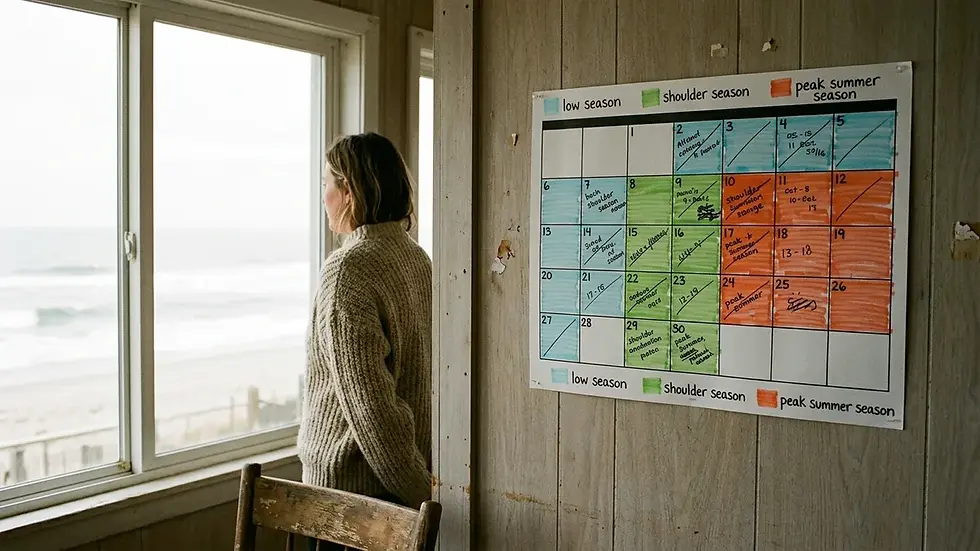
Seasonal revenue swings in Surf City are driven primarily by beach tourism demand cycles, with June through August generating roughly three times the monthly revenue of the January through February low season. AirROI's 2026 data shows peak-season months averaging $7,668 to $9,062 in monthly revenue with occupancy between 45.6% and 57.4%, compared to low-season months averaging $2,287 to $2,536 with occupancy near 24% to 27%.
July consistently ranks as the single strongest month across every dataset reviewed, with Crest & Cove reporting July revenue as high as $10,882 per listing and 65.5% occupancy. January is the softest month industry-wide, a pattern consistent with most Atlantic coastal markets from Wrightsville Beach to Topsail Beach.
Guests book Surf City listings an average of 67 days in advance according to AirROI, which gives owners a meaningful window to adjust pricing before peak dates lock in. Waiting until two weeks before a July weekend to raise rates misses most of that booking curve; the smarter play is setting aggressive peak pricing by early spring, then adjusting downward only if bookings lag.
Shoulder-season months, specifically April, May, September, and October, represent the biggest opportunity gap for Surf City owners. Hurricane season officially runs June through November on the Carolina coast, and while major storms remain relatively rare, that overlap with peak season means owners need flexible cancellation policies that protect revenue without scaring off bookings.
How Do Gross Revenue and Net Income Actually Compare?
Gross revenue is the total booking income a Surf City short-term rental generates before any expenses are subtracted, while net income is what remains after mortgage, taxes, cleaning, utilities, insurance, and management fees are deducted. Most market reports, including AirROI and Crest & Cove, report only gross figures, which creates a misleading picture of actual owner profitability.
A documented example makes this concrete. One North Topsail Drive property analyzed by Chalet showed $48,456 in annual gross revenue with 62.2% occupancy and a $246 ADR, numbers that look solid on paper. But once modeled expenses were applied, that same property showed a negative $41,952 net income. High mortgage payments, insurance costs typical of oceanfront and near-oceanfront property, and full-service turnover expenses had eaten through the entire gross revenue figure and then some.
By contrast, Chalet's highest-performing example property in the same market posted $108,924 in annual revenue with 77% occupancy, a $370 ADR, and 358 available booking days, suggesting a smaller, well-priced property with minimal owner-blocked dates and strong reviews can meaningfully outperform a larger property carrying heavier fixed costs.
A realistic net income model for a Surf City STR should deduct, at minimum: mortgage or opportunity cost of capital, property insurance (often higher near the coast due to flood risk; check FEMA flood mapping resources for your specific parcel), the 6% Surf City occupancy tax plus the additional 3% municipal tax and 3% Pender County tax cited by the Town of Surf City finance department, cleaning and turnover costs, platform commission fees from Airbnb and Vrbo, utilities, and any professional management fee. Full-service STR management fees in this market typically range from 15% to 30% of gross booking revenue, while co-hosting arrangements where the owner keeps listing ownership run closer to 10% to 18%.
How Does Surf City's Location Across Two Counties Affect Owners?
Surf City sits primarily within Pender County, though portions of Topsail Island's broader rental market extend into Onslow County, and this county split affects tax obligations for owners depending on exactly where a property sits. The Town of Surf City finance page explicitly notes that Surf City does not collect the Onslow County tax on rentals within its town limits, which matters if you are comparing your property to a listing just across a jurisdictional line.
Within Surf City town limits, owners owe a 6% occupancy tax payable to the Pender County Tourism Development Authority, due monthly by the 15th of the following month, with quarterly remittance allowed if the amount is $25 or less per quarter. Separately, the town's finance department also cites an additional 3% municipal tax and a 3% Pender County tax on rental transactions, layering multiple tax obligations onto the same booking.
Taxable gross receipts extend beyond the nightly rate. Per the town's finance guidance, cleaning fees, linen charges, reservation fees, pet fees, damage fees, and even credit card processing fees can count as taxable gross receipts. Owners who only calculate tax on the base nightly rate and ignore these ancillary charges risk underpaying and facing penalties during an audit.
Zoning matters too. A May 2026 planning board memo referenced in Surf City property research described short-term rentals as formally defined under the town's 2026 zoning update, permitted in several residential districts but not listed as a permitted use in the C-1 Central Business District or the MU Mixed Use district at that time. Confirm current zoning status directly with the Surf City zoning ordinance before purchasing or converting a property, since zoning classifications can change and vary by exact parcel.
What Should Property Owners Prioritize to Improve Revenue?
Improving STR revenue in Surf City requires prioritizing dynamic pricing over static rates, since AirROI's tier data shows top-performing properties consistently outperform median properties primarily through better rate management, not superior amenities. Owners can act on several specific levers in order of impact.
Adjust pricing weekly, not seasonally. With guests booking an average of 67 days out, static rates set months in advance miss both underpricing opportunities during high-demand weekends and overpricing risk during slow stretches.
Target shoulder-season occupancy specifically. April, May, September, and October show the widest gap between what top-tier and median properties earn; length-of-stay discounts and flexible minimum-stay policies fill these gaps better than blanket rate cuts.
Audit your true tax liability. Confirm you are correctly remitting the 6% occupancy tax plus municipal and county taxes on all taxable fees, not just the nightly rate, to avoid penalties that quietly erode margin.
Model net income, not just gross revenue. Build a spreadsheet that deducts mortgage, insurance, cleaning, taxes, and management fees before deciding whether your property's performance is actually healthy.
Distribute across multiple platforms. Relying solely on Airbnb misses the meaningful share of coastal NC travelers who search Vrbo and Booking.com first, particularly for family and multi-generational group trips common to Topsail Island.
Reassess your listing photography and description annually. Properties with dated photos or generic descriptions consistently underperform newer, better-staged competitors even at comparable price points.
At 3 Putt Properties, LLC, our revenue management approach for Surf City properties, including our own managed listing South Shore Chateau, treats pricing as a continuous process rather than a set-it-once task. We monitor competitive inventory, local booking pace, and seasonal demand curves in real time, which is a meaningfully different approach than Airbnb's built-in Smart Pricing tool, which tends to price conservatively and underweight true peak-demand windows in niche coastal markets.
Common Mistakes Surf City STR Owners Make
Several recurring mistakes separate underperforming Surf City properties from top-tier listings, and most are fixable without any capital investment. First, many owners set a single nightly rate for the entire year and adjust only when bookings feel slow, missing the compounding effect of proactive weekly rate changes.
Second, owners frequently underestimate insurance and flood-risk costs specific to barrier island properties, which can quietly turn a strong gross revenue number into a negative net income, as documented in the North Topsail Drive example above. Check current flood zone status through FEMA's flood map resources before assuming your insurance costs will match a comparable property a few blocks inland.
Third, owners commonly miscalculate their occupancy tax base by excluding cleaning fees, pet fees, and damage waivers from taxable gross receipts, a mistake the Town of Surf City's finance department explicitly warns against. Fourth, single-platform listing strategies leave revenue on the table since the multi-platform distribution standard, spanning Airbnb, Vrbo, and direct booking, has become close to a baseline expectation for competitive coastal properties in 2026.
If you are weighing whether to bring in outside help, our related guide on choosing a rental management company walks through the tradeoffs between DIY management and professional oversight in more depth. And if you are still deciding whether short-term rental ownership makes sense for a property you inherited or recently purchased, our vacation rental startup costs guide breaks down the first-year expenses new owners commonly underestimate.
Frequently Asked Questions
What vacation rentals are available in Surf City, North Carolina?
Surf City's vacation rental inventory includes roughly 733 to 752 active short-term rental listings as of 2026, ranging from smaller condos to large multi-generational beach houses. Properties like South Shore Chateau and Tide and Seek, both managed by 3 Putt Properties, LLC, represent the higher end of the market with private pools, ocean views, and game rooms designed for group travel.
Is STR still profitable in Surf City in 2026?
Yes, for well-managed properties. Revenue grew 19.6% year over year according to Crest & Cove, even as supply expanded over 50%, suggesting demand is keeping pace with new listings. Profitability depends heavily on active pricing management and accurate expense tracking rather than location alone.
What does STR revenue mean exactly?
STR revenue means the total gross booking income a short-term rental generates before expenses, taxes, and fees are deducted. It is typically expressed as annual revenue, monthly revenue, ADR, or RevPAR, and should never be confused with net profit.
How much does the average Vrbo or Airbnb owner make in Surf City?
Average annual revenue ranges from about $35,442 to $41,851 depending on the data source and measurement window, per 2026 AirROI and Crest & Cove reports. Median monthly revenue sits closer to $2,825 to $3,362, with top-tier properties earning far more.
What is the 80/20 pattern for Airbnb in Surf City?
It describes how a small share of top-performing listings, roughly the top 10%, capture occupancy above 75% and monthly revenue over $10,000, while median and lower-tier properties earn substantially less. The gap is driven mainly by pricing strategy rather than property size or amenities.
Do I need a permit to operate a short-term rental in Surf City?
Surf City's 2026 zoning update formally defines and permits short-term rentals in several residential districts, though certain commercial and mixed-use zones may have restrictions. Confirm your specific parcel's zoning status through the town's current zoning ordinance before listing a property.
How much is occupancy tax on a Surf City rental?
Surf City town limits carry a 6% occupancy tax payable to Pender County, plus additional municipal and county rental taxes, due monthly by the 15th of the following month. Taxable receipts include cleaning fees, pet fees, and damage waivers, not just the nightly rate.
The Bottom Line for Surf City Owners in 2026
STR revenue in Surf City averages between $35,442 and $41,851 annually depending on the dataset, but that headline number tells you almost nothing about whether your specific property is performing well. The real story is in the gap between top-tier properties earning $10,000-plus monthly and bottom-tier listings barely clearing $1,749. That gap is closed through active pricing, accurate tax compliance, and honest net income modeling, not through hoping the beach does the work for you.
As Topsail Island's supply keeps expanding, the properties that win in 2026 and beyond will be the ones treating revenue management as an ongoing discipline rather than a one-time setup task.

If your Surf City property's revenue numbers don't match what the market data above suggests is possible, it may be time for a closer look at your pricing strategy and operations. 3 Putt Properties, LLC manages short-term rentals across Surf City, Topsail Island, and the broader NC coast with dynamic pricing, listing optimization, and full-service turnover management built in. Reach out through 3puttproperties.com to talk through what professional management could mean for your specific property.
Written by Eric McCarty, Found, CEO at 3 Putt Properties, LLC
Content powered by inkSTR.co



Comments